
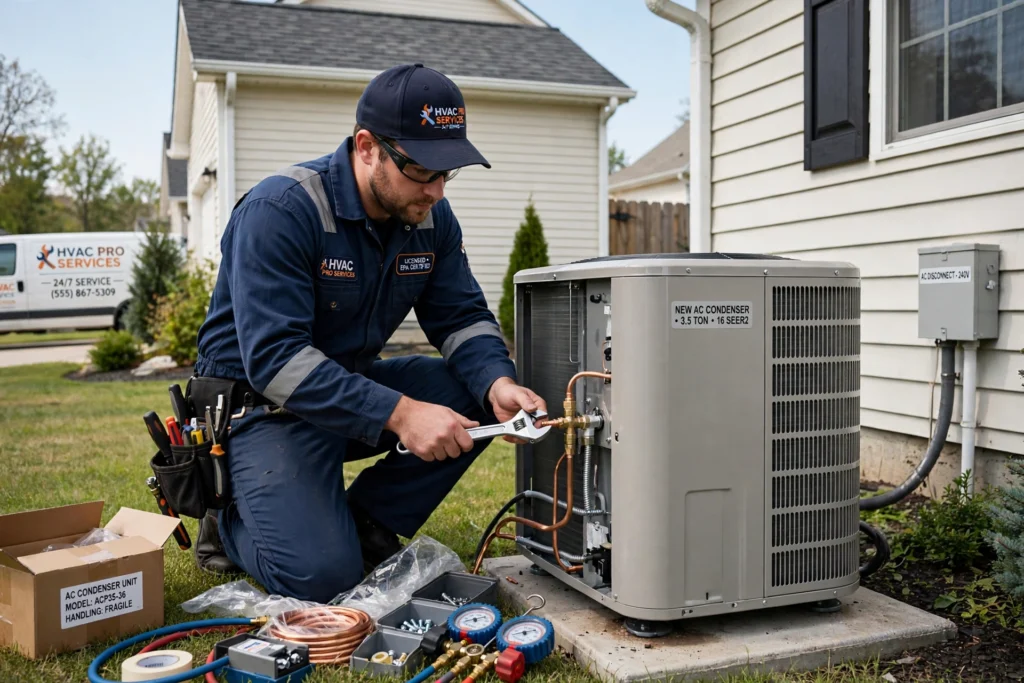
Short answer: A full HVAC system installation in 2026 typically costs between $5,000 and $22,000, with most homeowners paying around $7,500 for a complete replacement of their heating and cooling system, according to Angi’s 2026 cost data. Replacing only the air conditioner runs less — about $5,978 on average — while adding new ductwork can push the total well past $12,000. Your final price depends on your home’s size, the system’s efficiency rating, and whether your existing ductwork can be reused.
HVAC Installation Cost in 2026: Price Table
| Project Type | Average Cost | Typical Low–High Range |
|---|---|---|
| Full HVAC system replacement (AC + furnace) | $7,500 | $5,000 – $22,000 |
| Central AC unit replacement only | $5,978 | $3,887 – $8,073 |
| Furnace replacement only | $4,800 | $2,000 – $5,400 |
| Heat pump installation | $6,000 | $3,800 – $8,200 |
| New or replaced ductwork (add-on) | $4,000 | $2,100 – $7,500 |
Sources: Angi’s 2026 HVAC replacement cost data (full system average of $7,500; AC replacement average of $5,978); HomeGuide’s 2026 cost data for component ranges and ductwork pricing.
Notice how wide that full-system range is. A straightforward like-for-like replacement in a small home with healthy ducts lands near the bottom, while a larger home needing new ductwork, electrical upgrades, and high-efficiency equipment can climb toward $22,000. HomeGuide’s 2026 data tells a similar story: a typical full replacement of furnace plus air conditioner runs $5,000 to $11,000, but adding new ductwork stretches that to roughly $7,000 to $16,000.
What Affects the Price of HVAC Installation
1. Home size and system capacity (tonnage)
The single biggest price driver is how much heating and cooling your home actually needs. Contractors measure capacity in “tons” — one ton equals 12,000 BTU of cooling per hour. A 1.5-ton system for a small home typically installs for $3,650 to $6,250, while a 5-ton system for a large home runs $7,800 to $14,000, per industry cost data compiled from Angi’s 2026 figures. Bigger equipment costs more, but the per-ton price actually falls as systems get larger because labor, permits, and setup are partly fixed costs. Ask for a Manual J load calculation — the room-by-room sizing method professionals use — rather than accepting a quote based on square footage alone. An oversized system costs more upfront, cycles on and off too quickly, and leaves humidity problems behind.
2. SEER2 efficiency rating
Efficiency is measured in SEER2 (Seasonal Energy Efficiency Ratio 2) for cooling. Minimum federal standards were raised in 2023, and today’s systems typically range from about 14 SEER2 to over 20 SEER2 for premium variable-speed models. A higher rating adds $1,000 to $3,000 or more to the installed price but trims monthly energy bills. Whether the upgrade pays for itself depends on your climate: in hot regions where the AC runs half the year, the payback is fast. In milder areas, the mid-range unit is usually the smarter buy.
3. Ductwork condition
This is the hidden budget-killer. If your ducts are in good shape, reusing them saves thousands. If they’re leaky, undersized, or were never installed at all, new or replaced ductwork adds roughly $2,100 to $7,500 to the project. The U.S. Department of Energy estimates that leaky ducts can waste 20 to 30 percent of conditioned air, so a duct leakage test before the install can reveal whether sealing ($300 to $700) is enough — or whether full replacement is the real fix.
4. Brand and equipment tier
Premium brands like Trane, Carrier, and Lennox generally cost 10 to 25 percent more than budget-friendly names like Goodman or Rheem for comparable specifications. You’re paying partly for engineering and partly for dealer networks and warranty support. For furnaces specifically, HomeGuide’s 2026 data shows standard 80–89% AFUE gas models installing for $3,800 to $6,200, while high-efficiency 96%+ condensing models run $7,500 to $12,000 — a gap driven by both equipment and the PVC venting a condensing furnace requires.
5. Labor and region
Installation labor typically adds $1,500 or more to an AC-only job, and full-system installs involve a crew for one to three days. Labor rates run noticeably higher in the Northeast, Pacific Northwest, and major metro areas than in the Midwest or rural South. Permits add $250 to $400 in most jurisdictions, and extras like an electrical panel upgrade (often needed for heat pumps in older homes on 100-amp service) can add $2,000 or more.
Practical Ways to Save on HVAC Installation
- Know this first: the federal 25C tax credit is gone for 2026 installs. The credit that paid up to $2,000 toward a heat pump ended for equipment placed in service after December 31, 2025, when the One Big Beautiful Bill Act was signed. If your system was installed in 2025 or earlier, you can still claim it on your 2025 return — but new 2026 installations get no federal credit. Don’t let a salesperson promise otherwise.
- Claim your utility rebates instead. With the federal credit gone, utility and state rebates are the main savings in 2026 — and they’re real money. Examples: NV Energy’s PowerShift program pays $250 to $650 depending on equipment tier, Sacramento’s SMUD offers up to $3,000 for gas-to-electric heat pump conversions, and several utilities pay $1,000 to $2,000 for qualifying heat pumps. Check your utility’s website before you sign a contract, since rebates often require pre-approval or a participating contractor.
- Look into HEAR rebates if your income qualifies. The Home Electrification and Appliance Rebates program (federal funds administered by states) can cover up to $8,000 of a heat pump for households under 80% of area median income — but only in states that have launched the program, so confirm availability locally.
- Get three itemized written quotes. This is the oldest advice in the book and still the most effective. Demand a line-by-line breakdown — equipment, labor, permits, ductwork, thermostat — not a single lump sum. Quotes for identical-sounding systems can differ by 30 percent or more.
- Schedule in the off-season. Contractors are busiest in summer and mid-winter. Booking a replacement in spring or fall can mean faster scheduling and sometimes a better price.
- Repair vs. replace: do the math. If your AC is under 10 years old and the repair is minor, fixing it is almost always cheaper. Our AC repair cost guide breaks down typical repair prices so you can compare. As a rule of thumb, if the repair costs more than half the price of a new system — or your unit is 15+ years old — replacement is the better investment.
- Don’t skip the thermostat. A $150–$300 smart thermostat that learns your schedule can shave 8–10 percent off heating and cooling bills and costs almost nothing next to a $7,500 installation. Make it part of the quote.
Regional Notes: Sun Belt vs. Northern States
Sun Belt (Florida, Texas, Arizona, Southern California): Cooling dominates. Homeowners here often pair a high-SEER2 air conditioner or heat pump with a basic furnace, since heating loads are light. If you’re in one of these markets, also check our AC repair cost guide for Florida for region-specific pricing context. Because equipment runs hard most of the year, higher efficiency pays back faster — and higher electricity rates in states like California make that payback even quicker.
Northern states (Midwest, Northeast, Mountain West): Heating is the bigger bill. A high-AFUE gas furnace paired with a mid-range AC is the classic setup, and oil furnaces (common in the Northeast where gas lines are scarce) cost $6,400 to $9,200 installed per HomeGuide’s 2026 data. Cold-climate heat pumps are gaining ground here, but in sub-zero zones they usually need a furnace backup — budget for a dual-fuel setup rather than a standalone heat pump.
Mixed climates (Mid-Atlantic, Pacific Northwest): This is heat-pump sweet territory. Mild winters and warm-but-not-brutal summers let a single heat pump handle both jobs efficiently, which is why utility rebate programs in these regions (often $1,000 to $3,000) target heat pump conversions specifically.
Frequently Asked Questions
How long does an HVAC installation take?
A straightforward replacement using existing ductwork usually takes one to two days. Full system replacements with new ductwork, electrical upgrades, or venting changes can take three to five days. Your contractor should give you a firm timeline in writing before work starts.
Should I replace the furnace and AC at the same time?
If one unit is failing and the other is over 12–15 years old, replacing both together almost always makes sense. You save on labor (the crew is already there), the components are matched for efficiency, and you get a single warranty. A full system averages about $7,500 installed per Angi’s 2026 data — replacing the AC alone now and the furnace two years later typically costs more in total.
What SEER2 rating should I buy?
For most homeowners, 15–17 SEER2 is the sweet spot: above the federal minimums, meaningfully more efficient, without the steep premium of 20+ SEER2 variable-speed models. Go higher if you live in a hot climate with expensive electricity; go with a solid mid-range unit if your summers are mild.
Does a new HVAC system increase home value?
Generally, yes — appraisers and buyers both treat a new, efficient HVAC system as a plus, especially in extreme climates. You won’t recover the full $7,500 at resale, but a new system makes a home easier to sell and can be a deciding factor against comparable listings with aging equipment.
Can I install an HVAC system myself to save money?
No — and you shouldn’t try. HVAC installation involves refrigerant handling (which requires EPA certification), high-voltage electrical work, gas line connections, and permits with inspections. DIY installation voids the manufacturer’s warranty and can be genuinely dangerous. The labor portion of the bill is the one part you shouldn’t cut.
The Bottom Line
A new HVAC system is one of the biggest purchases a homeowner makes — but it’s also one of the most consequential for comfort and energy bills over the next 15 to 20 years. With full installations averaging around $7,500 in 2026 and ranging from $5,000 to $22,000, the spread between a smart buy and an overpriced one is enormous. Get three itemized quotes, insist on a proper load calculation, and check your utility rebates before you commit.
Please note: all prices in this guide are national estimates based on published 2026 industry data (Angi, HomeGuide) and will vary by region, home size, and contractor. For an accurate price on your home, get 2–3 written quotes from licensed local HVAC contractors.