
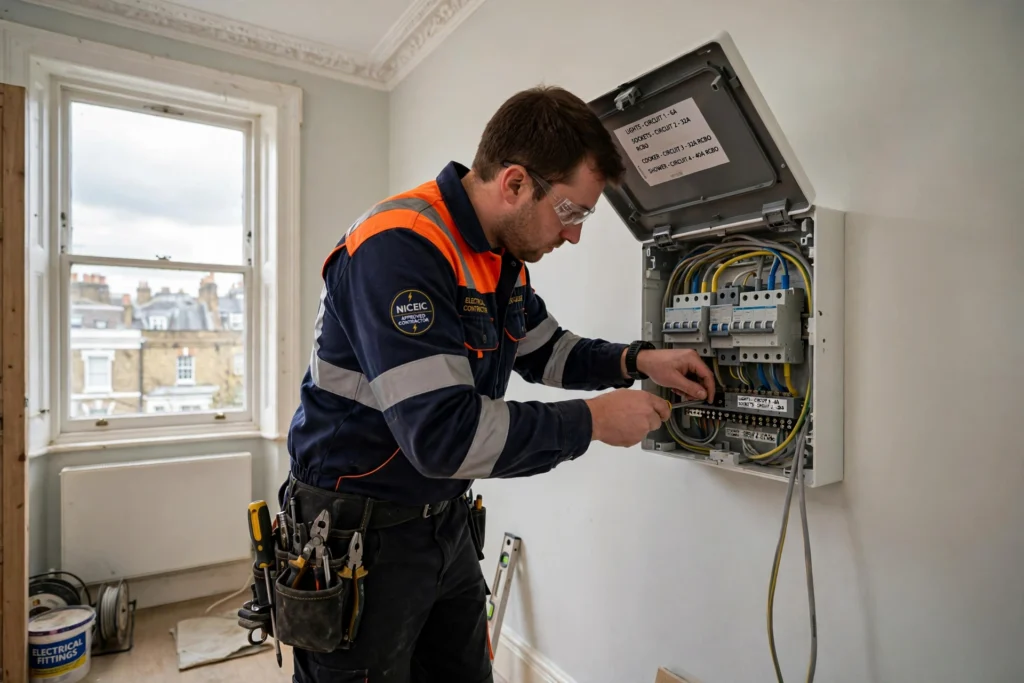
If you live in the capital and need electrical work done, expect to pay a premium over the rest of the country. In 2026, a qualified electrician in London typically charges £50 to £80 per hour, with a day rate of roughly £350 to £500, according to London-based firm OS Electrical Safety’s 2026 price guide. For common fixed-price jobs, Londoners are looking at £150–£200 for an EICR inspection of a one-bed flat, £500–£800 for a consumer unit replacement, and £3,000–£5,000 for a full rewire of a three-bed home.
Electrician Costs in London: Price Table for 2026
| Job | Average Cost | Low–High Range | Hourly/Day Rate |
|---|---|---|---|
| Hourly rate (standard hours) | ~£65 per hour | £50–£80 per hour | Labour only |
| Day rate (qualified electrician) | ~£425 per day | £350–£500 per day | Typically 8 hours |
| Emergency call-out | ~£90 per hour | £80–£100 per hour | Evenings, weekends, nights |
| Consumer unit (fuse box) replacement | ~£650 | £500–£800 | Usually 4–8 hours’ work |
| Full house rewire (3-bed) | ~£4,000 | £3,000–£5,000 | 5–10 days, fixed price |
| Partial rewire | ~£2,000 | £1,200–£3,000 | Depends on scope |
| EICR certificate (1-bed flat) | ~£175 | £150–£200 | 2–4 hours on site |
| EICR certificate (3-bed house) | ~£250 | £200–£300 | Plus report write-up |
| New socket installation | ~£115 | £80–£150 | 1–2 hours |
| Light fitting installation | ~£90 | £60–£120 | Around 1 hour |
Figures are drawn from OS Electrical Safety’s 2026 London price guide, Checkatrade’s 2026 UK cost guides, and MyBuilder’s 2026 socket cost guide. Note that the price of a full rewire in London can run considerably higher — MyJobQuote’s 2026 London rewire guide puts the range at £4,000–£13,000 depending on property size and complexity — so treat the table’s mid-range figures as a starting point, not a quote.
If you’re comparing against national benchmarks, it helps to know that electrician hourly rates across the UK in 2026 average £45–£60 per hour, so London’s £50–£80 band sits noticeably above the countrywide norm.
What Affects the Price of an Electrician in London?
The London premium
Electricians in London charge more than anywhere else in the UK, and it isn’t hard to see why. Higher business rates, the cost of operating a van in the capital (fuel, insurance, congestion and ULEZ charges), and strong demand all feed into the quote. Industry cost data consistently shows London day rates running £100 or more above the national average, and one 2026 landlord guide estimates London EICR prices run about a quarter higher than the rest of the country.
Job complexity and the age of your property
London has an unusually large stock of older homes — Victorian and Edwardian terraces, mansion blocks and converted flats — where original wiring can still be in place. Solid walls rather than stud partitions make running new cables slower and messier, and a rewire in a period property may involve chasing, lifting floorboards, and extra certification. A straightforward socket addition near existing wiring is a one-to-two-hour job; one requiring a new circuit run or access through masonry costs far more.
Emergency and out-of-hours call-outs
Standard rates apply during normal working hours. Need an electrician at 10pm, on a Sunday, or on a bank holiday? Checkatrade’s 2026 guide puts emergency rates at £80–£100 per hour, and many firms add a call-out charge or minimum billing period on top. A burning smell, sparking sockets or a fuse box that keeps tripping are genuine emergencies — call promptly, but ask for the emergency rate, call-out fee and VAT-inclusive total before the visit if the situation allows.
Certification and regulatory requirements
Notifiable electrical work in England must comply with Part P of the Building Regulations. Work like a consumer unit replacement or a full rewire must be carried out (or certified) by an electrician registered with a competent person scheme such as NICEIC or NAPIT, and the price of a proper job includes testing and the certificate. Be wary of quotes that skip paperwork — an EICR that costs under £80, for example, is a red flag: a competent inspection takes around two hours on site plus report time, and suspiciously cheap quotes often mean a rushed visit with most of the property listed as “limitations”.
Practical Money-Saving Tips
- Bundle small jobs into one visit. Many electricians have a minimum charge of one to two hours. Fitting three extra sockets and a new light fitting in a single visit is far cheaper per job than booking three separate call-outs.
- Get fixed-price quotes, not open-ended hourly billing. For anything beyond a quick fix, ask for a written fixed price. Ask exactly what is included: labour, materials, VAT, testing, and certification.
- Prepare the workspace. Move furniture, clear the fuse box area, and make sure the electrician has easy access. Time spent waiting or shifting boxes is billed time.
- Ask what the quote includes — especially VAT. Some firms quote excluding VAT at 20%. Always ask for the VAT-inclusive total, and check whether travel or a call-out fee applies.
- Supply your own fittings where it makes sense. If you want a specific designer light fitting or smart switch, buying it yourself can be cheaper than paying trade markup — but check with the electrician first that it’s compliant and suitable.
- Compare at least three written quotes for the same scope of work, and check the electrician is registered with NICEIC, NAPIT or another competent person scheme.

London Regional Notes
Central vs. outer London
Rates at the top of the ranges above — £70–£80 an hour and £500-a-day rates — are most common in central boroughs and Zone 1, where parking, access and the cost of doing business are highest. In outer London (places like Croydon, Bromley, Enfield or Harrow), rates tend to sit nearer the £50–£65-an-hour end of the band, closer to South East England pricing.
Parking and access surcharges
This is a genuinely London factor. Controlled parking zones, resident-only bays and limited-access developments mean electricians may add a travel or parking charge to the bill, particularly for central jobs. Ask upfront whether parking or congestion/ULEZ costs are included in the quote.
Finding a Part P registered electrician
Always verify that your electrician is registered with a government-approved competent person scheme — the main ones in England are NICEIC, NAPIT and ELECSA. Registration means they can self-certify notifiable work under Part P of the Building Regulations, and you’ll receive the proper compliance certificate, which matters when you come to sell or remortgage. You can check registration on the scheme’s own website before you book.
For landlords, the rules are stricter still: private rented homes need an EICR at least every five years, with fines of up to £30,000 for non-compliance. At London prices, a periodic EICR for a typical flat (£150–£200) is cheap insurance next to that.
Frequently Asked Questions
How much does an electrician cost per hour in London in 2026?
Most London electricians charge £50–£80 per hour during standard hours, averaging around £65. Expect the top end in central London and for specialist work, and £80–£100 per hour for emergency call-outs. For comparison with prices across the Atlantic, see our guide to electrician costs in Texas.
What is the average day rate for an electrician in London?
A qualified electrician’s day rate in London is typically £350–£500 for an eight-hour day. Day rates usually cover labour only; materials, testing and certification are quoted separately or bundled into a fixed project price.
How much is an EICR certificate in London?
Expect £150–£200 for a one-bed flat and £200–£300 for a three-bed house in London, according to 2026 London price data. Checkatrade’s national 2026 guide averages an EICR at around £212.50. London prices run roughly a quarter higher than the rest of the country.
How much does it cost to replace a consumer unit in London?
A like-for-like consumer unit (fuse box) replacement with modern RCD/RCBO protection, testing and certification typically costs £500–£800 in London. Checkatrade’s national 2026 guide puts the average at around £625. If the inspection uncovers further issues, remedial work is quoted separately.
Do I need a Part P registered electrician in London?
Yes, for most significant work. Notifiable jobs — new circuits, consumer unit replacements, rewires, and electrical work in kitchens and bathrooms — must comply with Part P of the Building Regulations. A registered electrician (NICEIC, NAPIT or similar) can self-certify the work and provide the compliance certificate.
Sources: OS Electrical Safety, “How Much Does an Electrician Cost in London? 2026 Price Guide” (published March 2026); Checkatrade’s 2026 electrician hourly rate guide and electrical safety check cost guide; MyBuilder’s 2026 new plug socket cost guide; TradeQuote AI’s 2026 UK electrician day rate guide; MyJobQuote’s 2026 London house rewire cost guide. Prices are estimates gathered from published UK trade cost guides in 2026. Your actual quote will depend on the property, the job, and the electrician — always get 2–3 local written quotes before committing.