
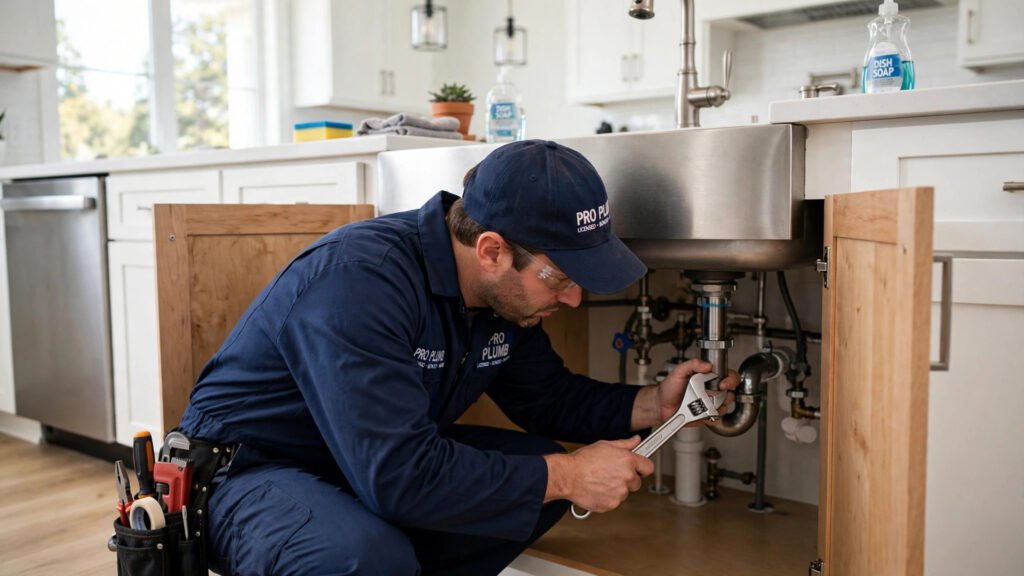
Hiring a plumber in 2026 costs about $340 on average for a standard repair, according to Angi’s 2026 cost data, with most projects landing between $182 and $500. Hourly rates typically run $45 to $200 per hour depending on the plumber’s licence level and where you live, and most plumbers charge a service call fee of $50 to $250 just to come out and diagnose the issue. If you need help at night or on a weekend, expect emergency rates of roughly $150 to $300 per hour.
HomeGuide’s 2026 guide puts the national average a little lower, at about $280 per job, with hourly rates of $45 to $150 and flat-rate job minimums around $200 to $250. The two sources paint the same overall picture: a straightforward fix usually costs a couple of hundred dollars, while larger work — like replacing a toilet or a water heater — can climb well past $1,000.
Plumber cost at a glance
The table below summarizes the key figures from published 2026 industry data, plus typical prices for common jobs. Use it as a quick reference before you start calling around for quotes.
| Charge or job | Typical cost in 2026 |
| Average plumbing repair | About $340 per job (Angi) |
| Typical cost range | $182–$500 (Angi) |
| Full reported range | Roughly $99–$988 (Angi) |
| Average cost per job | About $280 (HomeGuide) |
| Hourly rate | $45–$200 per hour |
| Flat-rate job minimum | About $200–$250 (HomeGuide) |
| Service call / trip fee | $50–$250 |
| Emergency / after-hours rate | $150–$300 per hour |
| Leaky faucet repair | $100–$300 |
| Drain clog clearing | $125–$350 |
| Toilet replacement | $300–$650 |
| Water heater replacement | $900–$2,200 |
These are national estimates, not quotes. Your final bill depends on your city, the plumber’s experience, and exactly what the job involves — which is why the sections below break down how plumbers charge and what moves the price up or down.
How plumbers charge: hourly vs. flat rate
Plumbers generally price their work in one of two ways: by the hour, or with a flat rate for the whole job. With hourly billing, you pay for the plumber’s time — usually $45 to $200 per hour, depending on licence level and region — plus parts. Simple, quick jobs are often billed this way, but the final total can be hard to predict if the plumber runs into complications behind a wall or under a floor.
With flat-rate pricing, the plumber quotes one fixed price for the entire job before starting. HomeGuide’s 2026 guide notes flat-rate minimums of about $200 to $250, which means even a 20-minute fix can cost that much once the plumber is on site. Flat rates give you cost certainty, and they are common for well-defined tasks like installing a toilet or replacing a faucet.
On top of labor, almost every plumber charges a service call or trip fee — typically $50 to $250 — to cover travel time, fuel, and the initial diagnosis. Some plumbers waive or credit this fee if you hire them for the repair; others charge it no matter what. Always ask whether the service call fee is separate from the repair quote or applied toward it.
Emergency and after-hours work is priced at a premium. Standard rates of $150 to $300 per hour are common for nights, weekends, and holidays, and some companies add a flat emergency dispatch fee on top. If the problem can wait until morning — a slow drip rather than a burst pipe — waiting can cut the bill dramatically.
What affects the cost of a plumber
No two plumbing jobs are identical, and several factors explain why one homeowner pays $150 while another pays $900 for what sounds like the same repair:
- Type and complexity of the job. A leaky faucet that needs a new washer is a quick fix; a hidden leak inside a wall requires cutting drywall, repairing the pipe, and patching the wall afterward. More labor hours and more materials mean a higher bill.
- Urgency and timing. Same-day, evening, weekend, and holiday calls carry premium rates of $150 to $300 per hour. Scheduling routine work on a weekday during business hours is one of the easiest ways to pay standard rates.
- Licence and experience level. Apprentices charge the least per hour, journeyman plumbers sit in the middle, and master plumbers — who can pull permits and handle complex systems — charge the most. The $45 to $200 hourly spread largely reflects this ladder.
- Region and cost of living. Plumbers in large metro areas and high-cost states charge more than those in small towns, simply because rent, wages, and insurance cost more there.
- Parts and materials. A basic faucet cartridge costs a few dollars; a premium fixture, a new toilet, or a water heater can add hundreds to the invoice. Ask whether the quote includes parts and which brands are being used.
- Access and working conditions. Pipes that are easy to reach — under a sink or in an open basement — are cheap to service. Pipes buried in a slab, hidden behind tile, or in a cramped crawl space take longer and cost more.
How to save money on a plumber
You cannot negotiate the laws of supply and demand, but you can absolutely lower your plumbing bill with a little planning:
- Bundle small jobs into one visit. Since every visit carries a $50 to $250 service call fee, group that dripping faucet, running toilet, and slow drain into a single appointment instead of paying three trip fees.
- Book on a weekday. Avoid after-hours, weekend, and holiday premiums ($150–$300 per hour) whenever the problem is not a true emergency. A bucket under a slow drip overnight is far cheaper than a midnight call-out.
- Compare two to three quotes. Prices vary widely between companies, so get at least two or three written estimates for any job over a few hundred dollars. Make sure each quote covers the same scope of work.
- Ask what is included. Confirm whether the price covers parts, labor, the service call fee, haul-away of old fixtures, and cleanup. A quote that looks cheap can grow quickly once extras are added.
- Shut off the water early. If you have a leak, turn off the fixture’s supply valve — or the main shutoff — right away. Limiting water damage keeps a plumbing bill from turning into a restoration bill.
Plumber cost FAQs
How much does a plumber cost per hour?
Most plumbers charge $45 to $200 per hour, depending on licence level and region. Angi’s 2026 cost data and HomeGuide’s 2026 guide both land in this neighborhood, with HomeGuide reporting $45 to $150 per hour. Master plumbers and big-city pros sit at the top of the range.
What is a typical plumber service call fee?
Expect $50 to $250 for the visit and diagnosis. Some companies apply the fee toward the repair if you hire them; others do not. Ask before booking so there are no surprises.
How much does an emergency plumber cost?
Emergency and after-hours plumbing typically runs $150 to $300 per hour — often double the standard rate — plus possible dispatch fees. Burst pipes, sewage backups, and gas line issues justify the premium; a slow drip usually does not.
Is it cheaper to hire a plumber on a weekday?
Yes. Weekday appointments during business hours are billed at standard rates, while evenings, weekends, and holidays trigger premium pricing. If the repair can safely wait, booking midweek is one of the simplest ways to save.
How can I lower my plumber’s bill?
Bundle multiple small repairs into one visit to pay a single service call fee, get two to three written quotes, confirm exactly what the price includes, and handle simple prep yourself — like clearing out under the sink so the plumber can get straight to work.
The bottom line
For 2026, budget around $340 for a typical plumbing repair (Angi’s 2026 cost data) or about $280 per job (HomeGuide’s 2026 guide), with most standard jobs falling between $182 and $500 and hourly rates of $45 to $200. These figures are estimates drawn from published industry data, so your actual quotes will vary by job, timing, and location — which is why it is smart to collect two or three local estimates before committing. To learn more about how we put these guides together, see our About Us page, and please read our Disclaimer: cost guides are starting points, not quotes.
Budgeting for the whole house? Browse more price guides in our Plumbing Costs category — and if you are pricing out other upkeep as well, take a look at our overview of house cleaning costs too.
Pingback: Plumber Cost in Texas: Hourly Rates & Average Prices – Home Service Cost Guide
Pingback: House Cleaning Cost in 2026: USA Average Prices – Home Service Cost Guide
Pingback: AC Repair Cost in 2026: Average Prices – Home Service Cost Guide
Pingback: Roof Replacement Cost in 2026: USA Guide – Home Service Cost Guide
Pingback: Electrician Cost in 2026: Hourly Rates & What You Pay Per Job – Home Service Cost Guide
Pingback: How Much Does House Cleaning Cost in London in 2026? – Home Service Cost Guide
Pingback: How Much Does a Plumber Cost in California in 2026? – Home Service Cost Guide
Pingback: How Much Does a Bathroom Remodel Cost in 2026? – Home Service Cost Guide